
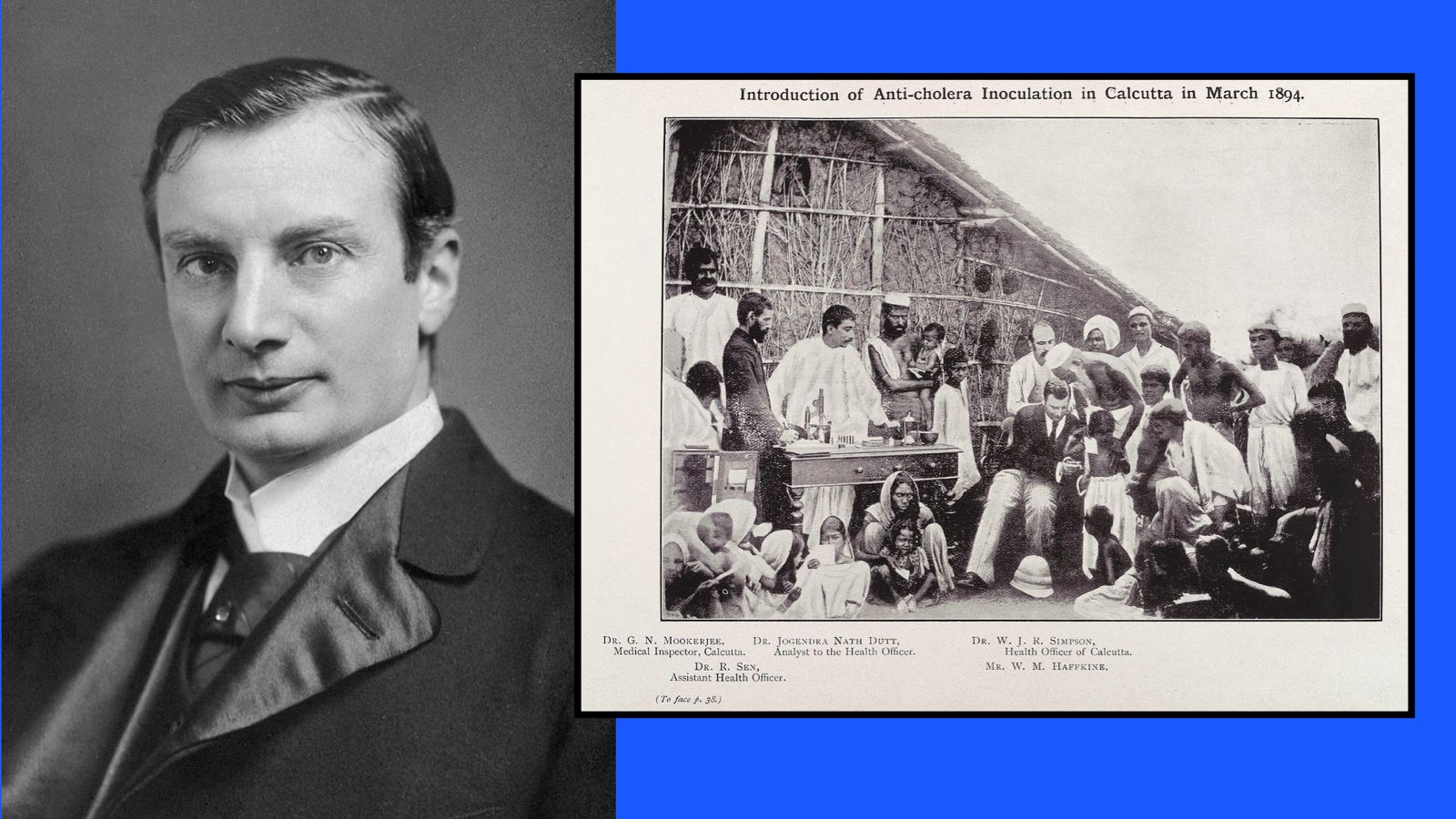
ON THIS DAY – 10 January 1897 – Ukrainian bacteriologist Waldemar Mordecai Haffkine performed the first human trial of a plague vaccine – on himself – during the devastating Bombay (Mumbai) epidemic of 1896-97.
Born in 1860 to a Jewish family in Odessa, then part of the Russian Empire, Haffkine studied physics, mathematics, and zoology at the University of Odessa before turning to bacteriology. In 1889 he joined the Pasteur Institute, where he developed a successful cholera inoculation. True to his bold scientific spirit, he tested it on himself in 1892 before bringing the vaccine to Calcutta in 1893, where it was used effectively.
By 1897, the Third Bubonic Plague Pandemic – originating in China and spreading rapidly across the world – had reached India. The disease arrived in Mumbai in September 1896, likely carried by plague-infected rats from ships travelling from Hong Kong. It spread swiftly through the city’s densely populated neighbourhoods, sending mortality rates soaring. Panic and mass flight followed, with almost half the city’s residents fleeing temporarily. Trade, port activity, and daily life ground to a halt under the weight of quarantines and a shrinking population.
The British colonial administration responded with aggressive public-health measures: forced evacuations, intrusive home inspections, widespread disinfection campaigns, segregation camps, and even the demolition of homes believed to be infected. These heavy-handed tactics fuelled mistrust and resistance among local communities.
Against this backdrop, the Plague Research Laboratory – today the Haffkine Institute – was established, and Haffkine was invited by the Governor of Bombay to develop a vaccine. After first testing it on himself on 10 January 1897, he launched a broader inoculation campaign. The results were remarkable: mortality among the vaccinated dropped sharply, and hundreds of thousands of people were eventually protected, saving countless lives.
Haffkine retired in 1914 and settled in France, eventually moving to Lausanne in Switzerland, where he lived until his death in 1930. He returned briefly to Odessa in 1927 but found it difficult to readjust.
His legacy is extraordinary. Joseph Lister hailed him as ‘a saviour of humanity’, and in Queen Victoria’s 1897 Diamond Jubilee Honours he was appointed a Companion of the Order of the Indian Empire. As The London Jewish Chronicle wrote in 2012, he was ‘a Ukraine Jew, trained in the schools of European science, [who] saves the lives of Hindus and Mohammedans and is decorated by the descendant of William the Conqueror and Alfred the Great.’