
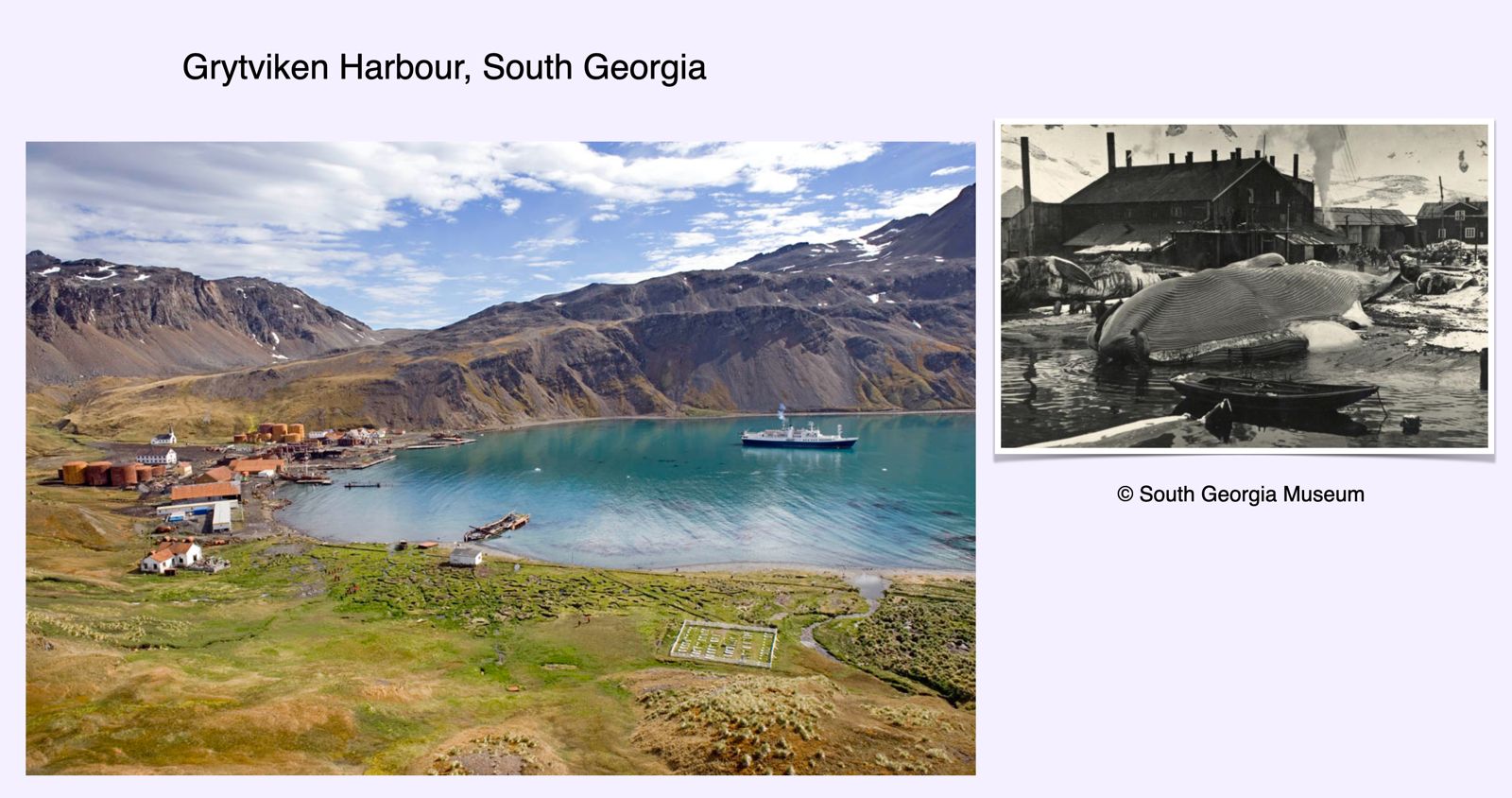
ON THIS DAY: 31 December 1966 – The last whaling season at South Georgia island came to an end – marking the close of industrial whaling in the Southern Hemisphere.
For over sixty years, the remote island of South Georgia, a British Overseas Territory in the South Atlantic, was one of the world’s busiest whaling centres. The first shore-based station opened at Grytviken in 1904, founded by Norwegian entrepreneur Carl Anton Larsen. Others soon followed at Leith Harbour, Stromness, Husvik, Prince Olav Harbour, and Godthul, attracting mainly Norwegian and British crews, along with workers from around the world.
During the 1920s and 1930s, the industry reached its peak. Tens of thousands of whales – blue, fin, humpback and others – were slaughtered each year. But relentless hunting soon devastated whale populations, and as numbers plummeted, profits declined. By the 1950s, the rise of factory ships made offshore processing more efficient, while growing international restrictions and changing public attitudes signalled that the era of whaling was ending.
Whales were prized not no much for their meat as for the oil extracted from their thick blubber – used to light lamps, lubricate machines, and later to make soap, margarine and cosmetics. Whale meat was sometimes eaten or turned into animal feed and fertiliser, and bones were ground for bone meal. Before plastics, the baleen from filter-feeding whales was used in corsets, umbrellas, and brushes, though its value faded by the mid-20th century.
When a whale was caught, it was hauled ashore to be flensedand rendered at the island’s industrial stations. Between 1904 and 1966, more than 175,000 whales were processed on South Georgia – a toll that drove the blue whale to the brink of extinction in the Southern Ocean.
Today, the island’s waters are a marine protected area, and whales – once nearly wiped out – are returning to South Georgia’s bays and feeding grounds, a powerful reminder of both human exploitation and nature’s resilience.