
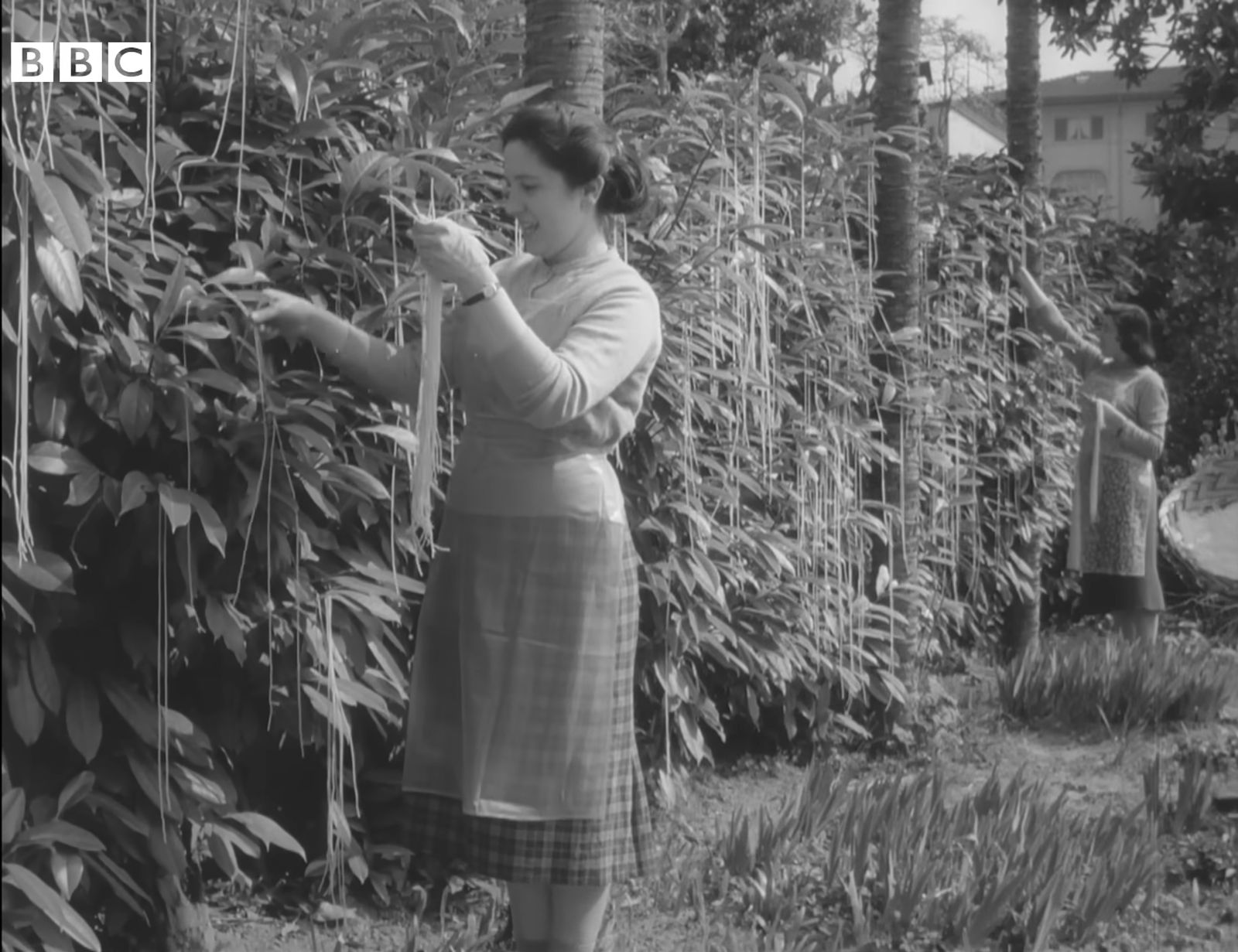
ON THIS DAY: 1 April 1957 – British viewers tuning in to the BBC’s news programme Panorama were treated to what would become one of the most famous April Fools’ pranks in broadcasting history: a straight-faced, three-minute report about a Swiss family harvesting spaghetti from trees in the canton of Ticino, near the Italian border.
The segment showed women carefully plucking strands of spaghetti from tree branches and laying them out to dry in the sun. The narration, delivered in the sober, authoritative tone viewers had come to expect, was voiced by respected broadcaster Richard Dimbleby, lending the story an air of complete credibility.
According to the report, Switzerland had enjoyed a ‘particularly heavy spaghetti crop’ that year, thanks to a mild winter and the ‘virtual disappearance of the spaghetti weevil’.
Remarkably, many people believed it. In 1957, spaghetti was not widely eaten in Britain, and few had seen how pasta was actually made. Television itself was still relatively new and deeply trusted, and Panorama was known as a serious and authoritative news programme. There seemed little reason to doubt what was presented.
The footage had been filmed in Ticino, the Italian-speaking region of southern Switzerland. With its ‘Mediterranean feel’, the location convincingly supported the illusion that spaghetti might somehow grow there.
The result was that thousands of viewers reportedly contacted the BBC to ask how they could grow their own spaghetti trees. The BBC’s now-legendary reply was delightfully understated: ‘Place a sprig of spaghetti in a tin of tomato sauce and hope for the best.’
Nearly seven decades later, the spaghetti tree hoax remains a brilliant example of deadpan humour – and a reminder of just how powerful (and persuasive) early television could be.