
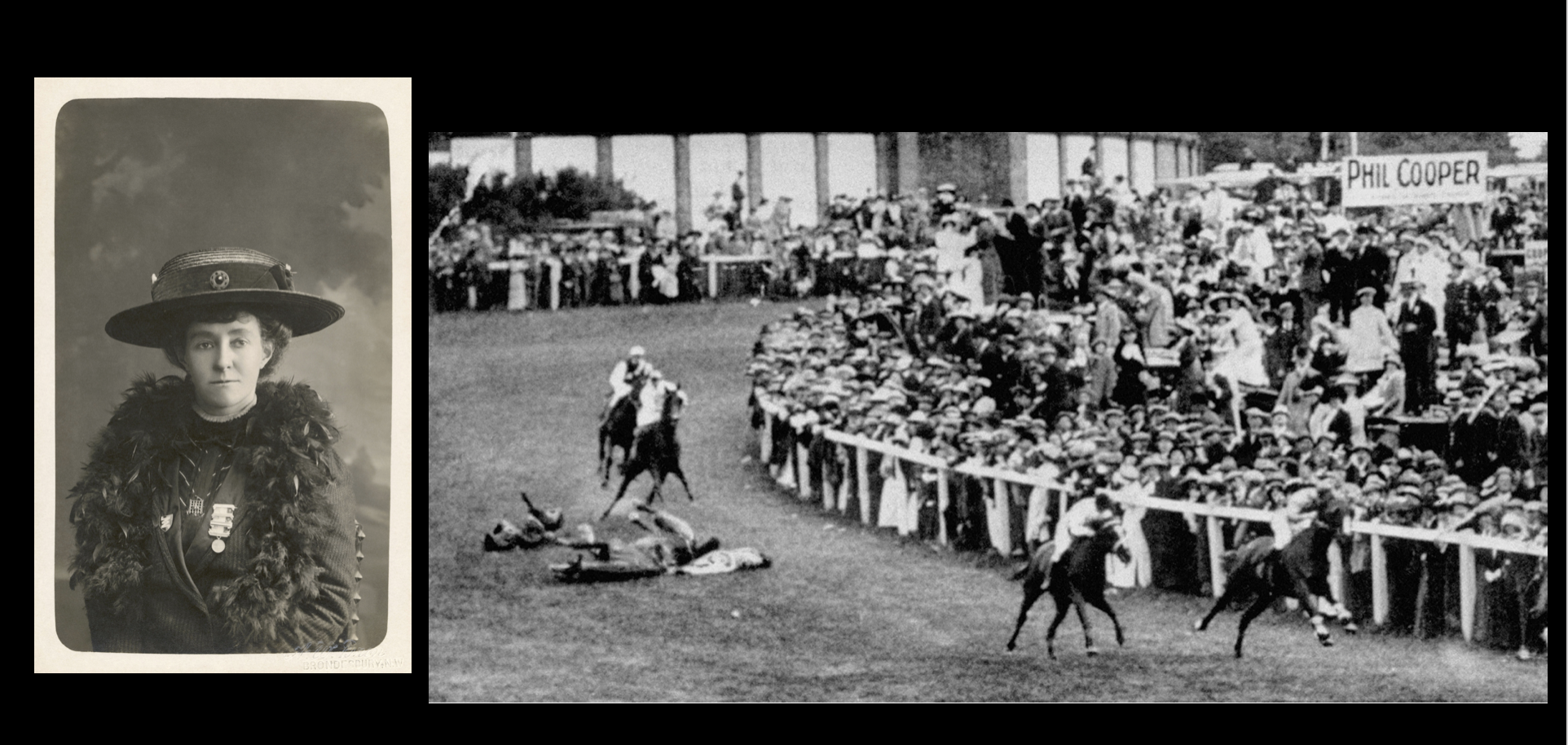
ON THIS DAY: 4 June 1913 – during the running of the famous Epsom Derby at Epsom Downs Racecourse, Emily Wilding Davison stepped onto the racetrack as the horses thundered past. She was struck by the horse Anmer, owned by King George V. The collision knocked Davison to the ground and brought down both horse and jockey. She suffered severe injuries and died four days later, on 8 June 1913.
Davison was one of the most committed and militant members of the women’s suffrage movement in Britain. Born in London in 1872, she was educated at Royal Holloway and later studied at Oxford, although women at the time could not receive full degrees there. She became involved with the militant suffrage organisation the Women’s Social and Political Union, led by Emmeline Pankhurst.
Davison believed peaceful protest alone was not forcing the government to grant women the vote. She took part in increasingly militant actions including protests, window-smashing campaigns and setting fire to post boxes. She was arrested several times and endured force-feeding in prison after going on hunger strike. In one dramatic protest in 1911 she hid overnight inside the Palace of Westminster so she could claim the House of Commons as her official address on the census.
Exactly what Davison intended that day has been debated ever since. Some contemporaries believed she meant to sacrifice herself for the cause. Others argue she intended only to attach suffragette colours to the King’s horse or disrupt the race as a dramatic protest, not to die. Modern film footage suggests she moved toward Anmer specifically, possibly trying to grab the horse’s bridle. A return train ticket and invitations found in her handbag have often been cited as evidence that she may not have intended suicide.
Her funeral in London became a huge suffragette demonstration, with thousands of women marching in procession behind her coffin. To many supporters she became a martyr for women’s voting rights.
Women over thirty gained the right to vote in Britain in 1918, and equal voting rights with men followed in 1928. Davison’s death remains one of the most famous and controversial moments in the history of the British suffrage movement.