
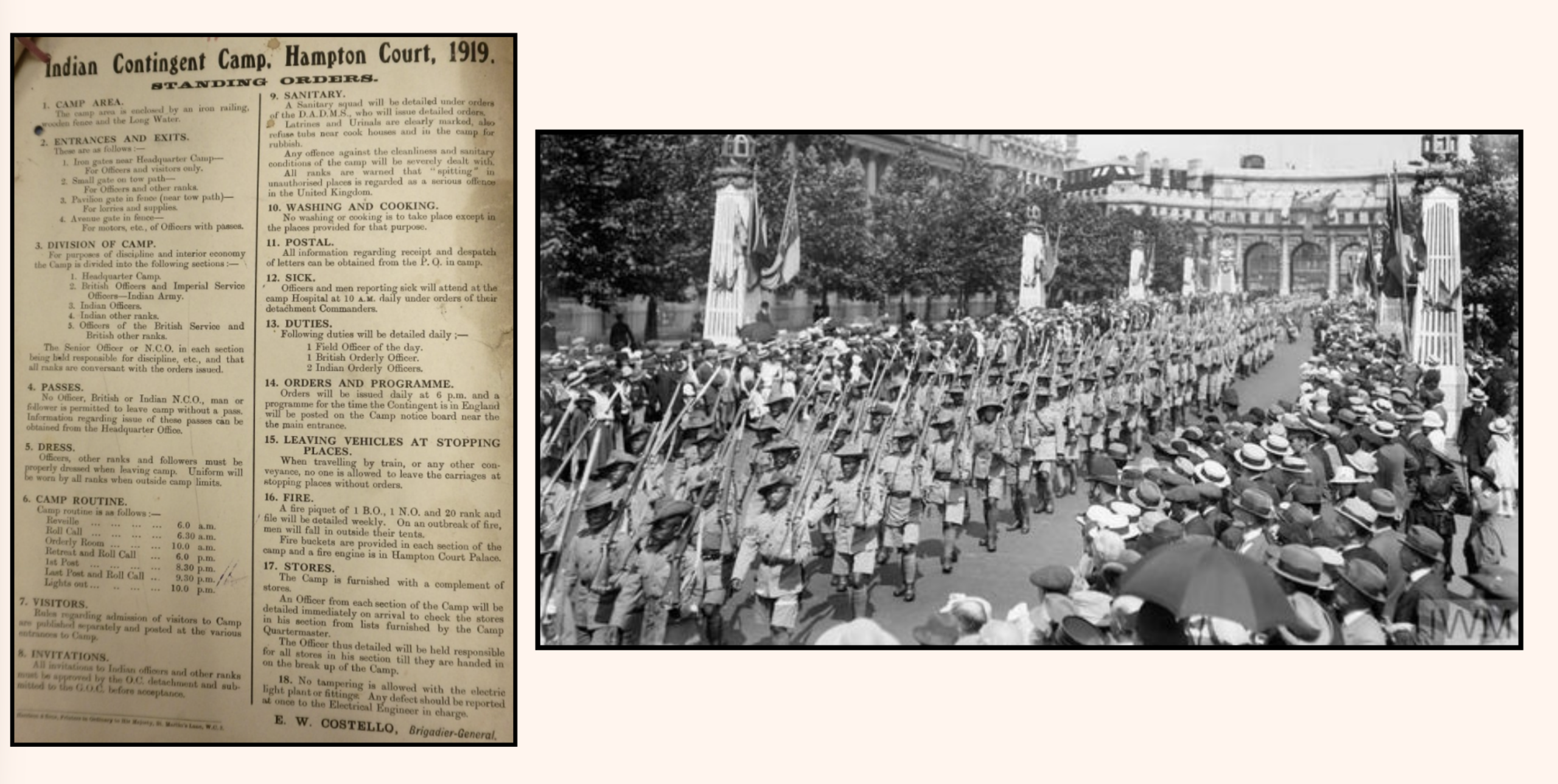
ON THIS DAY: 26 July 1919 – One of the most remarkable, yet largely forgotten, episodes in British history took place when nearly 1,800 officers, soldiers and civilian camp followers of the Indian Army arrived at Hampton Court Palace.
For the next two months, they lived in a specially constructed tented camp in Home Park before taking part in Britain’s post-First World War peace celebrations. Their presence recognised the extraordinary contribution of the Indian Army, with more than half a million soldiers serving during the war. They fought not only on the Western Front in France and Belgium, but also in Gallipoli, Mesopotamia (modern Iraq), East Africa and Palestine. Around 74,000 Indian soldiers lost their lives.
A special ‘Peace Contingent’ had been assembled in India to represent this immense sacrifice. Sailing from Bombay (now Mumbai), they hoped to take part in London’s Victory Parade on 19 July 1919. However, the Treaty of Versailles was signed while they were still at sea, and delays meant they missed the celebrations. Their ordeal worsened when influenza broke out aboard the transport ship, claiming the lives of five men before they reached Britain.
Determined that their service should not go unrecognised, King George V ordered that the contingent receive a celebration of its own.
After arriving by train at Hampton Court, the men marched into Home Park, where an enormous camp of bell tents had been laid out beside the River Thames. Every effort was made to respect the soldiers’ diverse religious and cultural traditions, with separate facilities for Sikh, Hindu and Muslim cooking, places of worship, slaughterhouses prepared according to religious requirements, laundries and sanitation. The camp also featured sports fields, a YMCA cinema tent, lectures and organised entertainment, while soldiers were given passes to explore London.
On 2 August 1919, the contingent travelled by special train from Hampton Court to Waterloo before marching through London to Buckingham Palace. Thousands lined the streets to cheer as regiments carrying banners bearing the names of battlefields such as France and Palestine passed by.
At Buckingham Palace, King George V reviewed the troops and presented decorations. Among those honoured was Naik Karanbahadur Rana, who received the Victoria Cross, Britain’s highest award for gallantry.
It was a fitting tribute to the courage and sacrifice of the Indian Army – a chapter of Britain’s First World War history that deserves to be remembered.