
ON THIS DAY: 30 May 1971 – Norman Wilkinson, the British inventor of dazzle camouflage for ships during World War I, died on this day.
During World War I, German submarines (U-boats) posed a severe threat to Allied shipping. Traditional camouflage – making ships blend into the sea – proved ineffective, because ships were still visible on the open water.
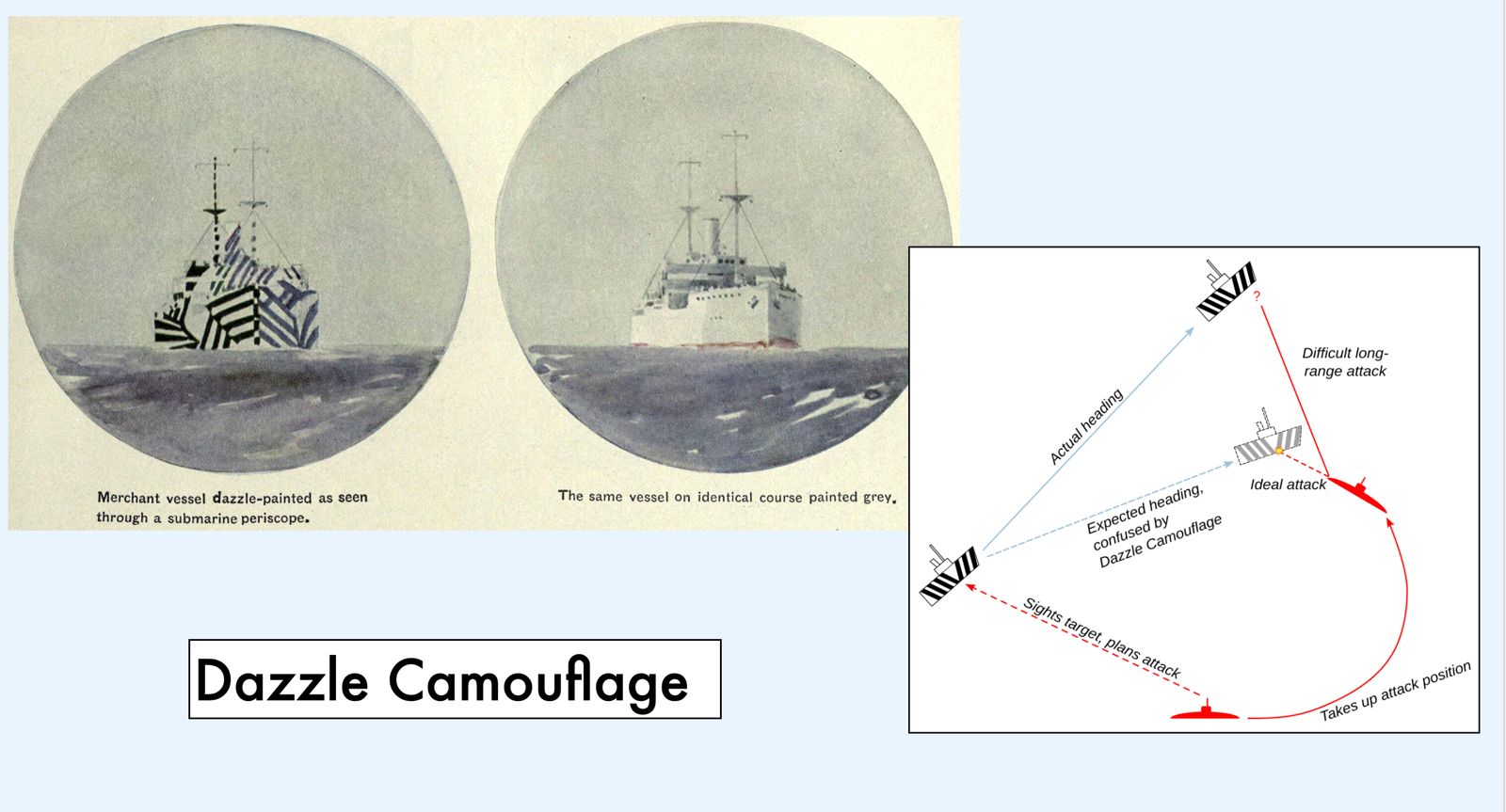
Wilkinson’s idea at the time was radical. Instead of trying to hide ships, he proposed making them hard to aim at. Ships were painted with bold, contrasting geometric patterns – zigzags, curves, and stripes.
The aim was to confuse enemy submarine crews trying to estimate a ship’s direction, speed, and distance. This made it much harder to fire accurate torpedoes, and the system became known as ‘dazzle camouflage’ or ‘razzle dazzle.’ Hundreds of British ships were painted in this way, and the technique was later adopted by the United States Navy and the French Navy.
Before the war, Wilkinson had worked as a marine artist and illustrator, and after the war he continued his artistic career. He became president of the Royal Institute of Painters in Water Colours and designed posters, murals, and commercial artwork. During World War II, he once again contributed to camouflage and naval art efforts.
Interestingly, dazzle-style face paint – known as CV Dazzle, developed by artist Adam Harvey and inspired by Wilkinson’s work – has been shown to interfere with some facial-recognition systems. However, as these technologies have become more advanced, particularly with the rise of deep learning, they have also become increasingly difficult to fool.