
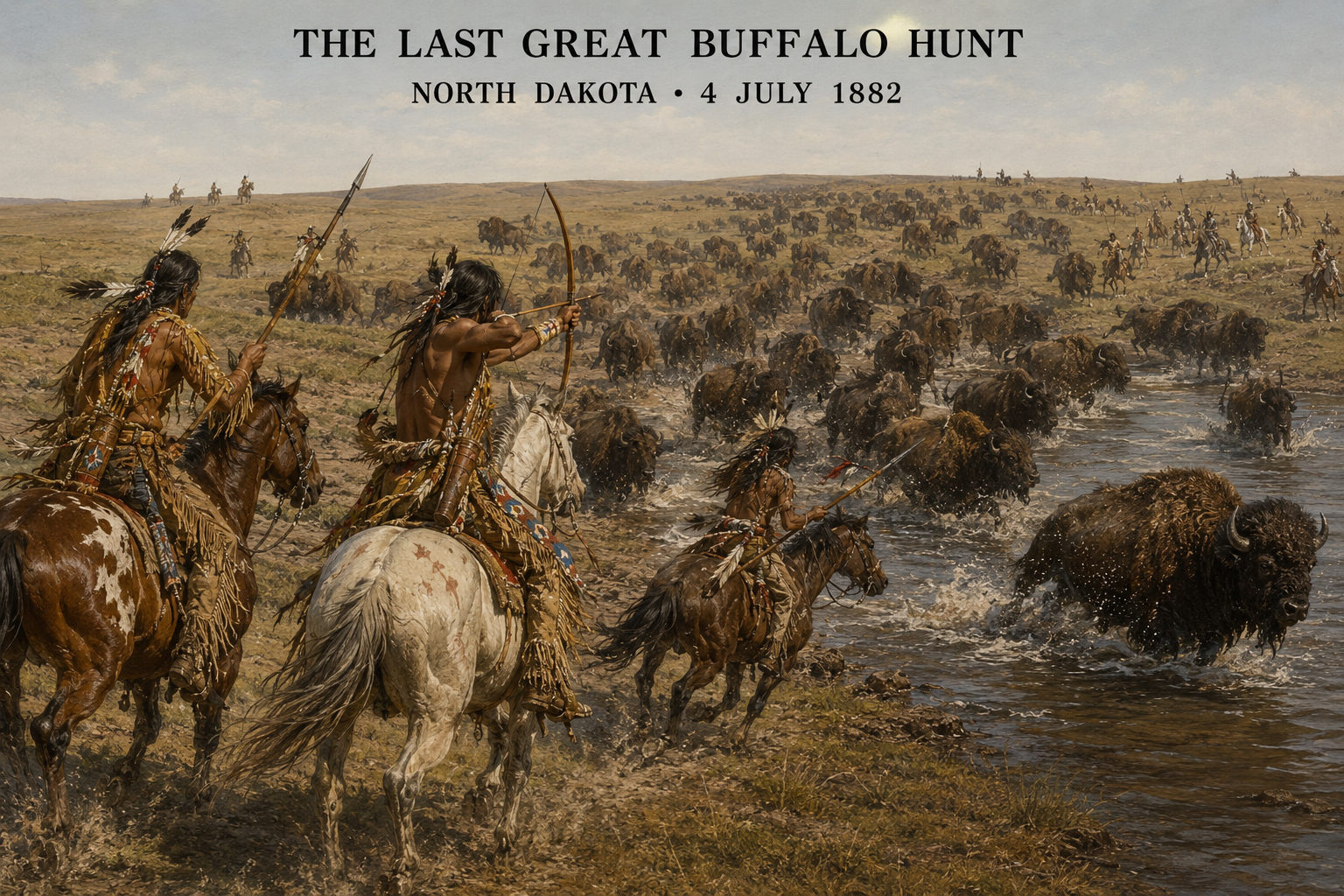
ON THIS DAY: 4 July 1882 – The ‘Last Great Buffalo Hunt’ began on the northern Great Plains near Hettinger, North Dakota. Thousands of Lakota and Yanktonai Sioux accompanied by their families left reservation lands near the Standing Rock Agency to join the hunt.
For centuries, the buffalo (American bison) had been the foundation of Plains Indigenous life, providing food, clothing, shelter, tools, and spiritual meaning. By the early 1880s, however, commercial hunting and government policies had reduced herds that once numbered in the tens of millions to only a few scattered groups.
In the summer of 1882, scouts discovered one of the last substantial buffalo herds remaining in the region west of the reservation. More than 600 mounted Lakota and Yanktonai hunters, accompanied by their families, set out in pursuit. During the hunt they killed approximately 5,000 buffalo, providing desperately needed meat, hides, and supplies for reservation communities facing hardship and dependence on government rations.
Although the 1882 hunt was enormous, it was not quite the final destruction of the northern herd. By 1883, perhaps only about 10,000 buffalo remained in the Hiddenwood Creek area near Hettinger. In October 1883, a much larger hunting expedition led by followers of Sitting Bull killed over 5,000 animals, after which white hunters finished off most of the survivors. The great free-ranging buffalo herds of the northern plains had effectively disappeared.
The Last Great Buffalo Hunt of 1882 is more of a symbolic title than a strictly literal one as the 1883 hunt was the final slaughter of the remnants of the northern herd. However, both hunts symbolise both the resilience of the Plains tribes and the profound changes forced upon them during the reservation era. The disappearance of the buffalo meant the loss of the economic and cultural foundation of traditional Plains life, increasing dependence on the U.S. government and marking the end of an era that had lasted for centuries.