
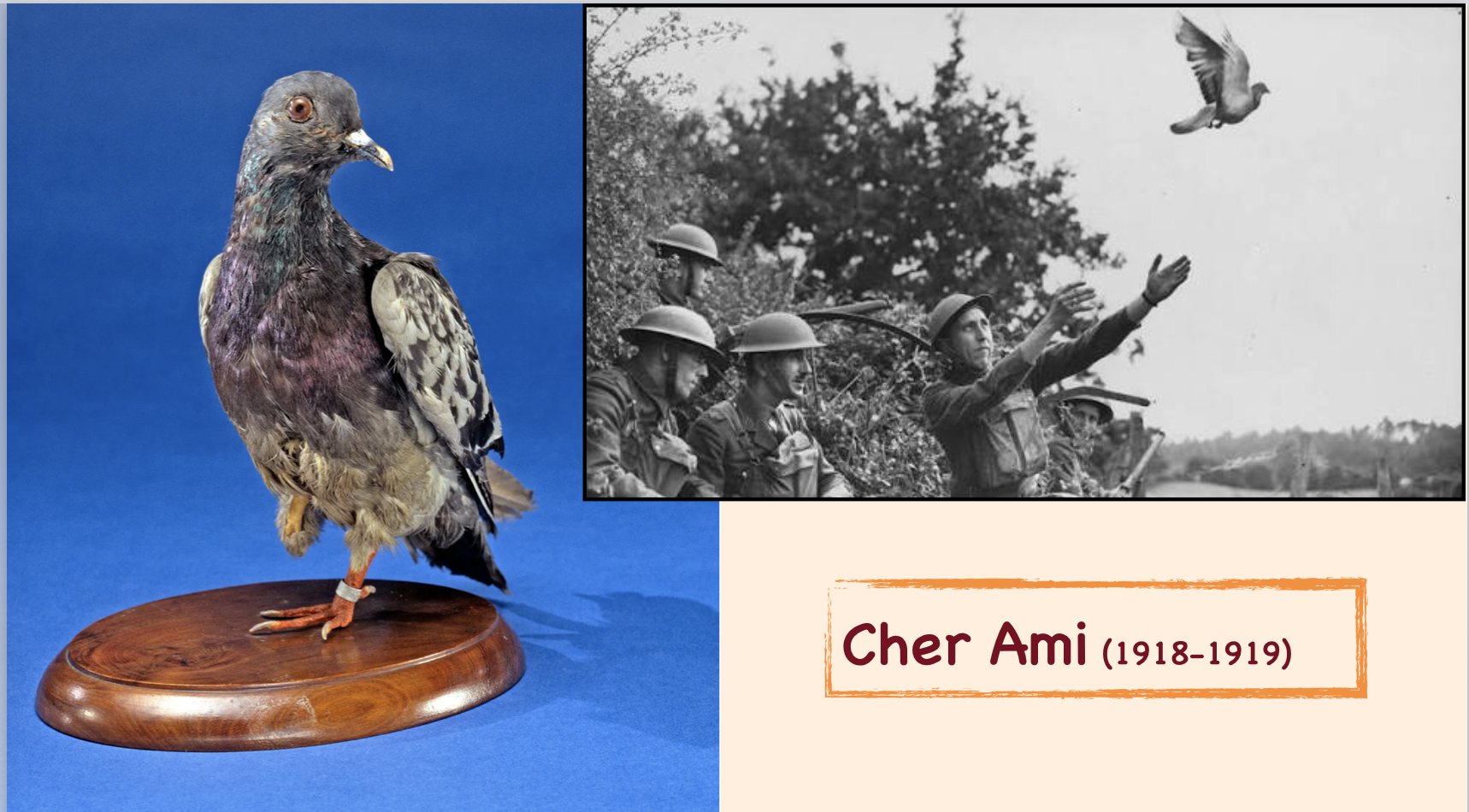
ON THIS DAY: 4 October 1918 – Cher Ami, a homing pigeon, saved a battalion of American soldiers.
Cher Ami – French for ‘Dear Friend’ – was a homing pigeon serving with the U.S. Army Signal Corps during the First World War. His bravery on 4 October 1918 would make him one of the most famous animals of the war.
His most famous mission came during the Meuse-Argonne Offensive, when around 500 American soldiers of the 77th Division became trapped behind German lines in the Argonne Forest. They became known as the ‘Lost Battalion.’
Their situation was desperate. Cut off from the rest of the American forces, they were not only under attack from the Germans but were also being accidentally shelled by their own artillery. Their position had been lost, and attempts to send messages by pigeon had already failed – several birds had been shot down or disappeared.
Finally, on the afternoon of 4 October, the battalion commander, Major Charles Whittlesey, entrusted a crucial message to Cher Ami. It gave the location of the trapped soldiers and pleaded with the American artillery to stop firing on them.
Cher Ami was released. He flew straight into a terrifying barrage of German bullets and shellfire. Somehow, despite the chaos around him, he reached the American lines. But he had been catastrophically wounded. A bullet or shell fragment had almost severed his right leg and torn through his breast. Yet the message capsule was still attached to his leg.
The message was delivered. The Americans finally knew the exact location of the Lost Battalion, and the artillery barrage was stopped. The trapped soldiers were eventually relieved on 7 October.
Army medics treated Cher Ami, but his right leg had to be amputated. Despite his terrible injuries, he survived and was returned to the United States in April 1919, where he became a national celebrity.
The French government awarded him the Croix de Guerre with palm, one of France’s highest military decorations for bravery.
Sadly, Cher Ami died on 13 June 1919, probably as a result of his wartime injuries. His body was preserved by the Army and eventually donated to the Smithsonian Institution, where he remains one of its most famous historical objects.