
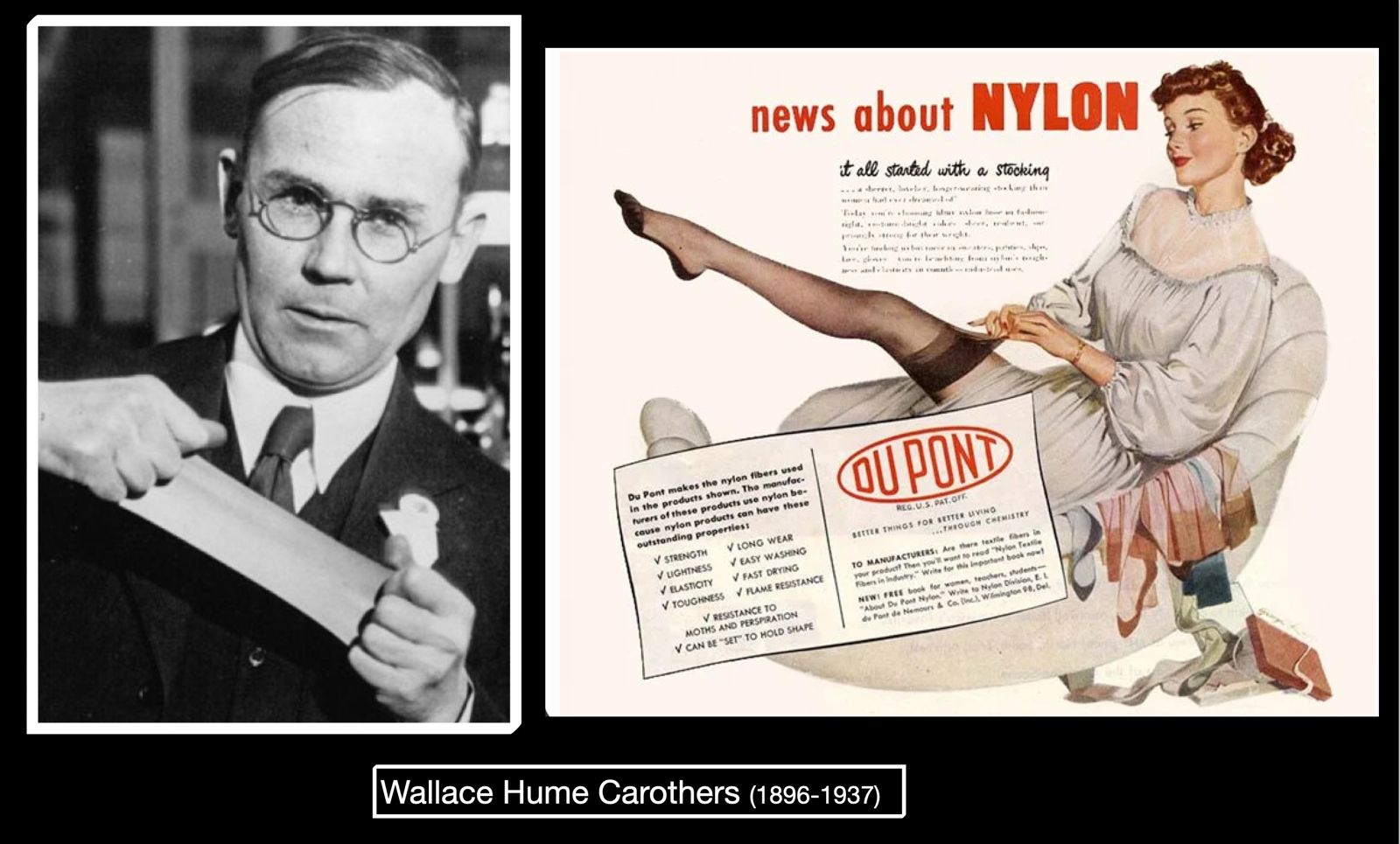
ON THIS DAY: 24 October 1939 – something extraordinary happened in Wilmington, Delaware, USA: nylon stockings went on sale to the public for the very first time. The day became known as ‘Nylon Day’ – and women couldn’t get enough of them!
Nylon had been developed by a team of chemists at DuPont, led by the brilliant American chemist Wallace Hume Carothers. The breakthrough came in 1935, when Carothers and his team created a new synthetic polymer, later known as nylon 66. It could be spun into long, strong and remarkably elastic fibres. Nylon was patented that same year.
DuPont quickly realised that this revolutionary new material could transform women’s hosiery. At the time, silk stockings were enormously popular, but silk was expensive, delicate and prone to runs. Nylon promised something better: a stocking that was strong, smooth, sheer and relatively inexpensive.
DuPont initially experimented with names such as ‘No-Run’ – although this was abandoned when the early stockings rather inconveniently did run! The name nylon eventually stuck.
On ‘Nylon Day’, only around 4,000 pairs were available, sold through a handful of local shops for approximately $1.15–$1.35 a pair. Women queued outside the stores, desperate to get their hands on this exciting new product. The entire supply disappeared in about three hours. One Wilmington retailer reportedly sold its allocation of 600 pairs in approximately an hour.
For women accustomed to silk, nylon seemed almost miraculous. It was sheer, smooth, strong and relatively inexpensive – and it quickly became a sensation. There was also an important political and economic reason for DuPont’s enthusiasm. Japan was America’s principal source of silk, and tensions between the two countries were already extremely high. Nylon offered the possibility of replacing Japanese silk with an American-made synthetic fibre.
When the United States entered the Second World War in December 1941, nylon suddenly became strategically important. It was used for parachutes, aircraft components, cords and other military equipment. In 1942, DuPont stopped producing nylon stockings for civilian use, diverting virtually all nylon to the war effort.
Women were so desperate for stockings that old pairs were mended and remade, while some women even painted their legs with make-up to create the illusion of wearing stockings!
And when nylon stockings finally returned to the shops after the war, demand was so enormous that the resulting scenes became known as the ‘nylon riots’.
Sadly, Carothers suffered depression and committed suicide on 29 April 1937 at the age of 41. He never lived to see nylon stockings.