
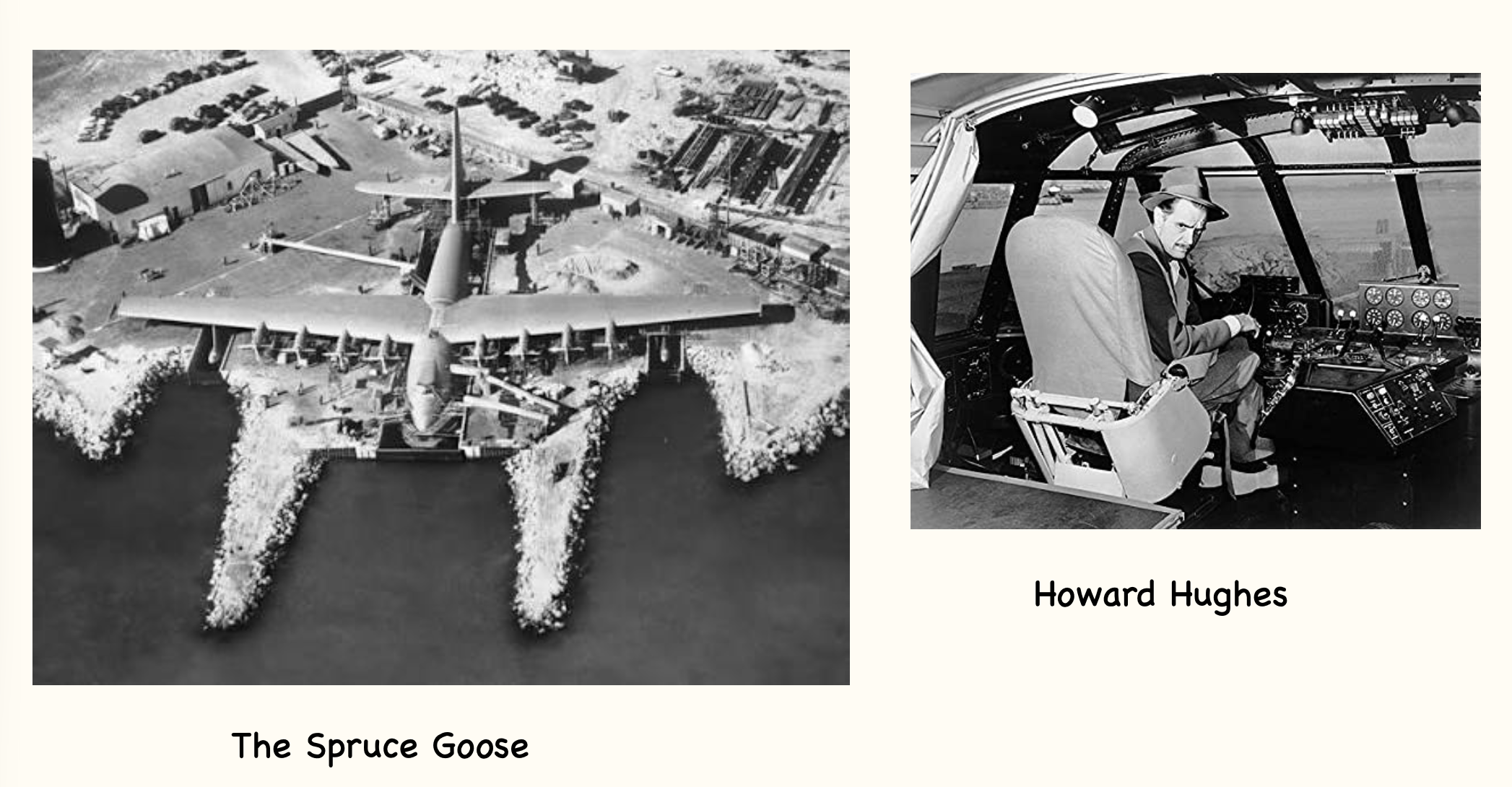
ON THIS DAY: 2 November 1947 – eccentric American billionaire, film producer and aviation pioneer Howard Hughes piloted the Spruce Goose, the largest wooden aircraft ever built, on its first and only flight!
The enormous Hughes H-4 Hercules, better known as the Spruce Goose, rose from the waters of Long Beach Harbor, California, briefly proving that this extraordinary machine could fly.
The aircraft was conceived in 1942 in collaboration with American industrialist and shipbuilder Henry J. Kaiser. The plan was to build giant flying boats capable of transporting up to 750 fully equipped troops, or military cargo, across the Atlantic during the Second World War. Its hull was designed to float on water, serving as the aircraft’s landing gear.
The Spruce Goose was truly colossal: Wingspan: 319 ft 11 in (97.5 metres), Length: 218 ft 8 in (66.6 metres), Height: 79 ft 4 in (24.2 metres), Engines: Eight, and Maximum take-off weight: 400,000 lbs (181 tonnes).
Perhaps the most extraordinary feature was its construction. The aircraft was made almost entirely from laminated birch wood rather than aluminium, which was in high demand during the war. It used a process called Duramold, in which thin layers of wood were moulded together under heat and pressure to create strong, lightweight structural components.
In 1944, Kaiser withdrew from the project. Delays, technical challenges and escalating costs meant that the aircraft was not completed until 1946, by which time the war was over.
Nevertheless, on 2 November 1947, Hughes took the controls himself. The test flight lasted approximately 30 seconds, with the giant aircraft reaching an altitude of around 70 feet (21 metres) above the water and covering roughly a mile before landing safely. It was a remarkable achievement, although it never demonstrated that it could carry a full military payload across the Atlantic.
With no practical use for the aircraft after the war, the Spruce Goose never flew again. Hughes kept it in a specially maintained hangar, reportedly preserving it in flight-ready condition until his death in 1976.
Today, this extraordinary feat of engineering is preserved at the Evergreen Aviation & Space Museum in McMinnville, Oregon. After spending years on display in Long Beach, it was dismantled, transported to Oregon in the early 1990s and reassembled at the museum.