
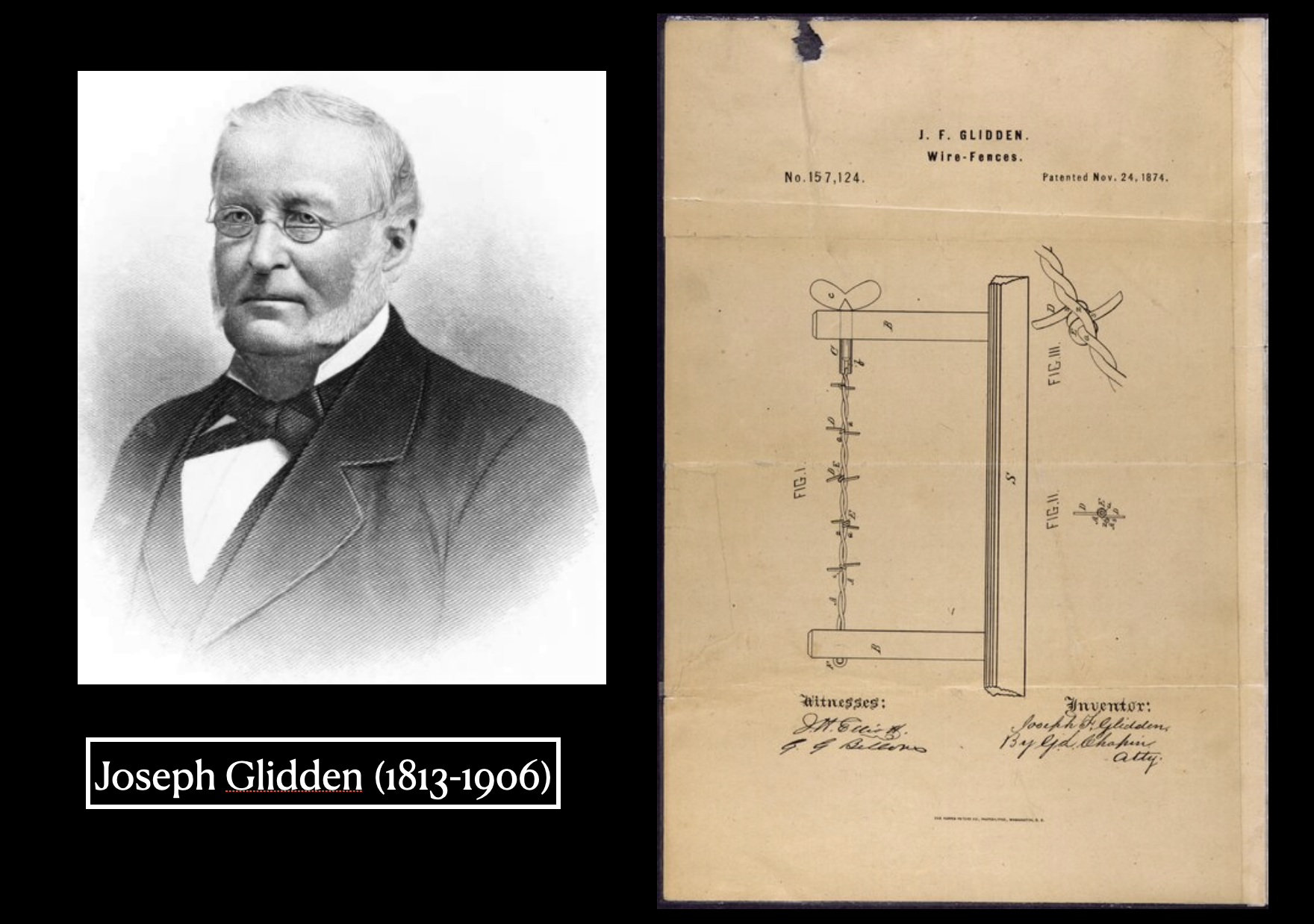
ON THIS DAY: 24 November 1874 – American farmer Joseph Glidden patented his improved design of barbed wire, an invention that would transform farming and ranching across the American West.
Living in DeKalb, Illinois, Glidden wanted a cheap and effective way to keep cattle out of his crops. Wooden fencing was expensive and difficult to obtain on the largely treeless Great Plains, where cattle roamed freely across vast expanses of land.
Glidden’s ingenious solution was to attach short, sharp pieces of wire to two twisted strands, holding the barbs firmly in place. He reportedly experimented with making the wire on his farm before using it to fence his wife’s vegetable garden.
His design, known as The Winner, could be manufactured relatively cheaply and on a large scale. Farmers quickly adopted it to protect their land and crops, while ranchers increasingly found their traditional grazing grounds divided by fences. Barbed wire helped bring an end to the era of the open range, dramatically reshaping the landscape of the American West.
Yet this simple invention had a more complicated legacy. The rapid spread of fencing led to violent disputes over land ownership and grazing rights, culminating in the Fence-Cutting Wars in Texas during the 1880s.
Before barbed wire became widely available, cattle ranchers could graze their herds across enormous stretches of unfenced prairie. Cowboys drove cattle over long distances, and although land ownership existed, boundaries were often not physically marked by fences.
Barbed wire changed everything. Farmers and large landowners could suddenly enclose huge tracts of land relatively cheaply, preventing cattle from wandering onto their property. However, these fences also blocked access to waterholes, traditional grazing grounds and routes used by cattle drovers.
The drought of 1883 made matters worse, as grass and water became scarce. Competition intensified between those who depended on open grazing and landowners who had enclosed their property. Armed groups of fence cutters, some known as the Owls, Javelinas and Blue Devils, rode out at night to slash miles of barbed wire. Some even left threats warning landowners not to rebuild their fences.
Ranchers retaliated by hiring armed guards to protect their property. Violent confrontations followed, and at least three men were killed in clashes between fence cutters and ranchers.
In January 1884, Texas Governor John Ireland convened a special legislative session. The resulting laws made deliberate fence cutting a felony punishable by one to five years in prison. They also prohibited the unauthorised fencing of other people’s land and required gates in fences crossing public roads at intervals of three miles. Texas Rangers were deployed to apprehend offenders.
Meanwhile, Glidden’s invention was making him a fortune. His successful design brought him considerable wealth through business interests and royalties, and by the time he died in 1906, aged 93, he was one of the most prosperous men in his community.