
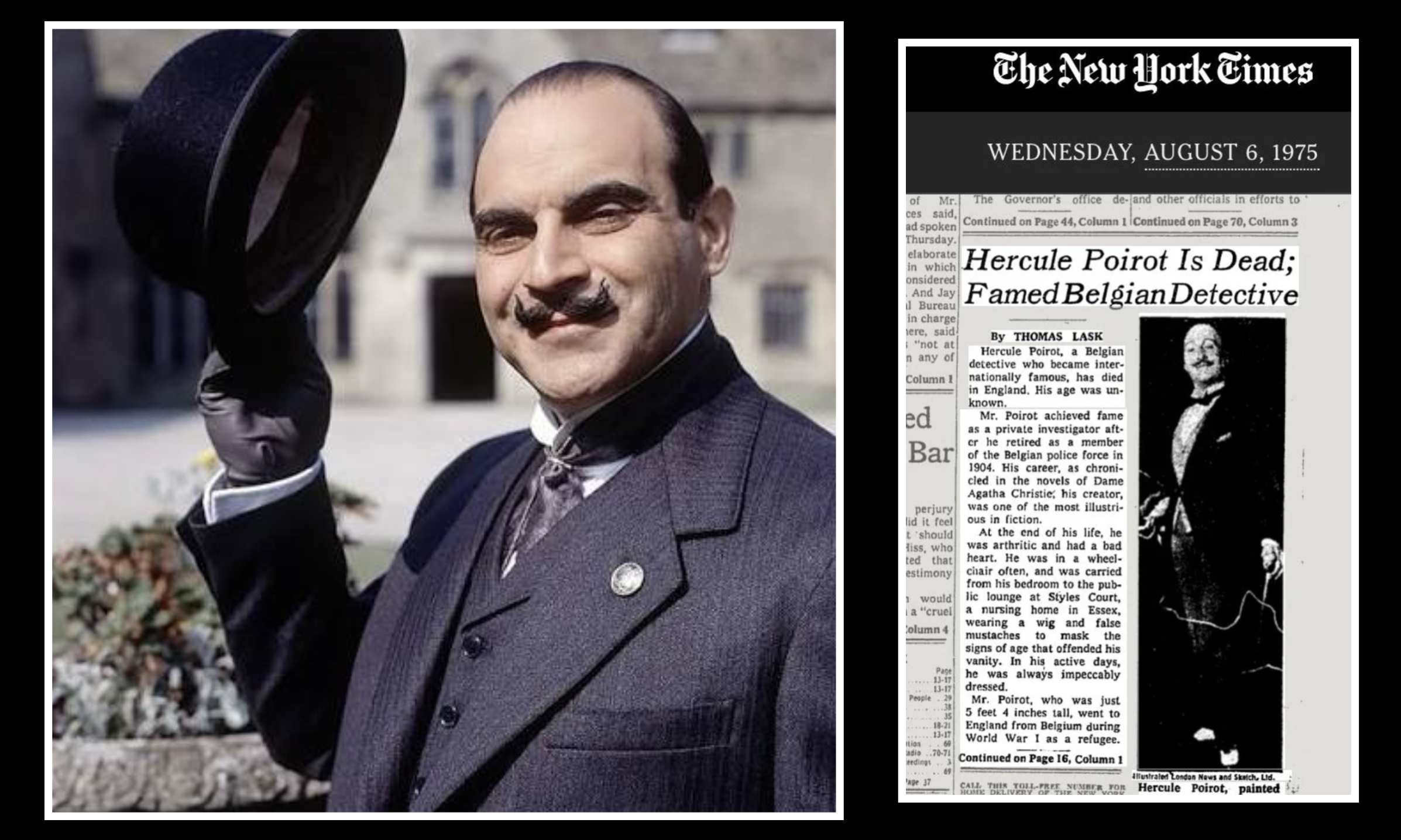
ON THIS DAY: 6 August 1975 – Agatha Christie’s famous Belgian detective, Hercule Poirot, became the only fictional character to receive an obituary on the front page of The New York Times. It appeared shortly after the publication of Curtain: Poirot’s Last Case, the final Poirot novel.
The newspaper treated Poirot’s death as though he were a real person. The obituary opened with the memorable words: ‘Hercule Poirot, the world’s most celebrated Belgian detective, died in England.’
It went on to recount his ‘career’ as fact, describing his arrival in England as a refugee after the First World War, his extraordinary record of solving crimes, and his meticulous methods. It even paid tribute to his trademark waxed moustache, immaculate appearance, and reliance on his famous ‘little grey cells.’
The obituary also reflected on Poirot’s extraordinary cultural impact. By 1975, he had appeared in more than 30 novels, dozens of short stories, and countless stage, radio and television adaptations. To millions of readers, he had become as real as many historical figures.
The article noted that Poirot had outlived many of his fellow fictional detectives and that his creator had finally decided to bring his long career to an end. In a remarkable twist, Agatha Christie was still alive when her most famous creation ‘died’ – an unusual reversal in literary history.
Christie had actually written Curtain during the Second World War, around 1940, intending it to be published only after her death or retirement. Instead, she kept the manuscript locked away in a bank vault for more than 30 years. When it was finally released in 1975, readers discovered that the great Belgian detective met his end after solving one last, unforgettable case.
The obituary was both a tribute to Poirot and a recognition of Christie’s extraordinary achievement. Few fictional characters have become so beloved that a newspaper of record considered their passing worthy of front-page news – a distinction Hercule Poirot still holds today.