
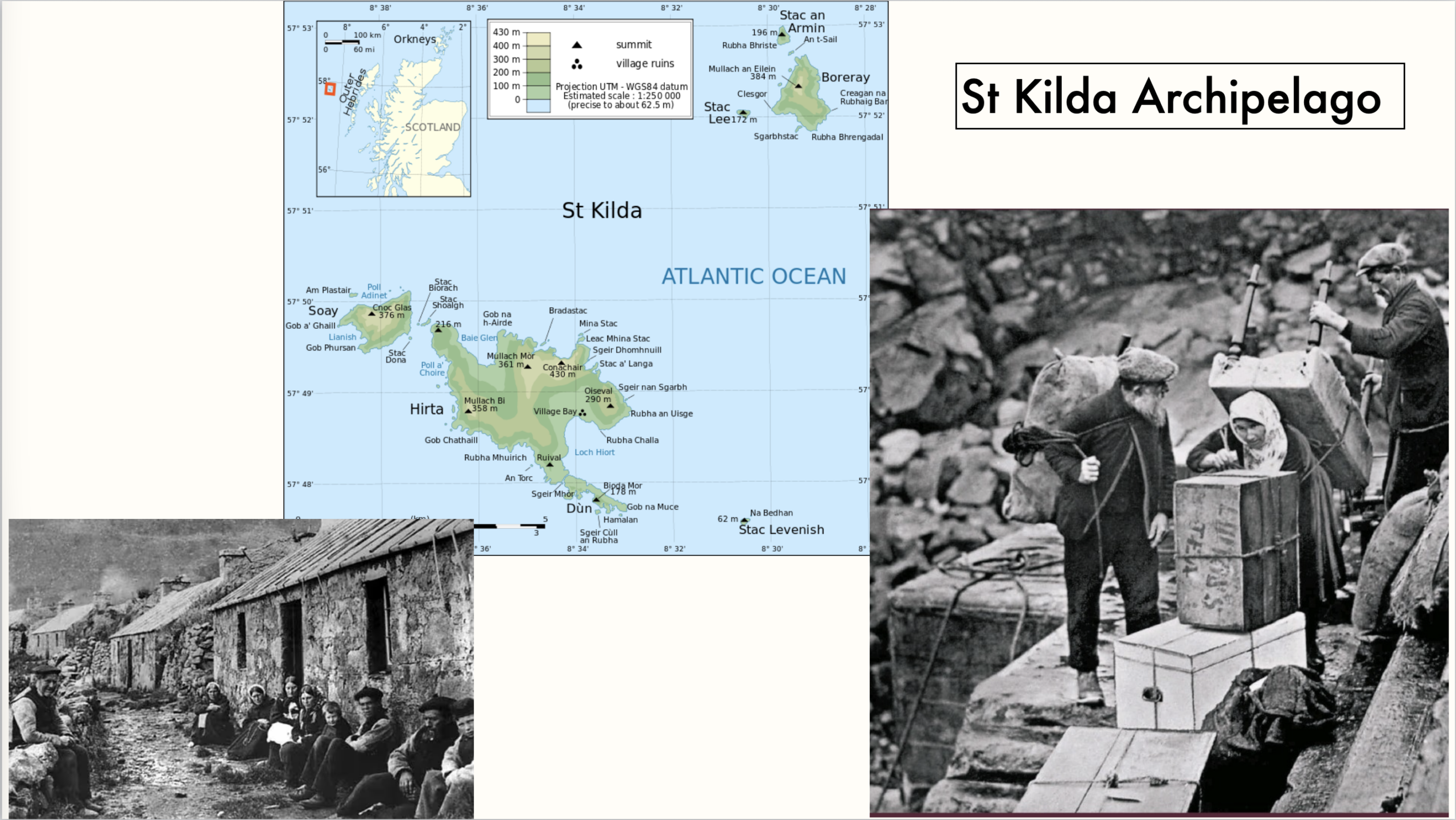
ON THIS DAY: 29 August 1930 – The last 36 residents of St Kilda were evacuated from one of Britain’s oldest and most isolated communities, bringing to an end more than 4,000 years of continuous human settlement on the remote Scottish archipelago.
In the early hours of 29 August, the islanders packed their belongings aboard the government vessel HMS Harebell. Before leaving, they observed an old St Kildan tradition: in every cottage they left an open Bible and a small pile of oats before locking the door behind them for the final time. It was a poignant gesture, symbolising their hope that one day life might return to the island.
Lying around 40 miles (64 km) west of the Outer Hebrides, St Kilda – agro of islands – is lashed by Atlantic storms and surrounded by some of Britain’s highest sea cliffs. For centuries, its people survived through extraordinary resilience and self-sufficiency. They cultivated small plots of land, kept sheep, and harvested thousands of seabirds, along with their eggs and feathers, by scaling towering cliffs with ropes and remarkable skill.
By the early 20th century, however, life on St Kilda had become increasingly unsustainable. Greater contact with the mainland brought new ideas and goods, but also disease. Influenza outbreaks, food shortages and the steady departure of younger islanders caused the population to dwindle. During the First World War, a Royal Navy presence provided regular supplies and communication, but when the military left, the island’s isolation returned.
The final turning point came in January 1930 when a young woman, Mary Gillies, fell seriously ill. Although she was transported to the mainland, she died in hospital. Her death convinced many islanders that St Kilda could no longer provide the medical care and security needed for modern life. In May 1930, the remaining residents formally petitioned the Secretary of State for Scotland to evacuate them.
The 36 evacuees – 13 men, 10 women, 8 girls and 5 boys – rescued from Hirta, the mainland of the St Kilda archipelago, reached mainland Scotland after a voyage of around 17 hours. Many settled in Morvern, where the men found work with the Forestry Commission, while others built new lives in Inverness-shire, Ross-shire and Fife. Although they adapted to their new surroundings, many never stopped longing for the close-knit community and freedom they had left behind.
Today, St Kilda is uninhabited except for seasonal conservation workers and a small military presence. Managed by the National Trust for Scotland, it is the UK’s only UNESCO World Heritage Site recognised for both its outstanding natural heritage and its cultural significance.