
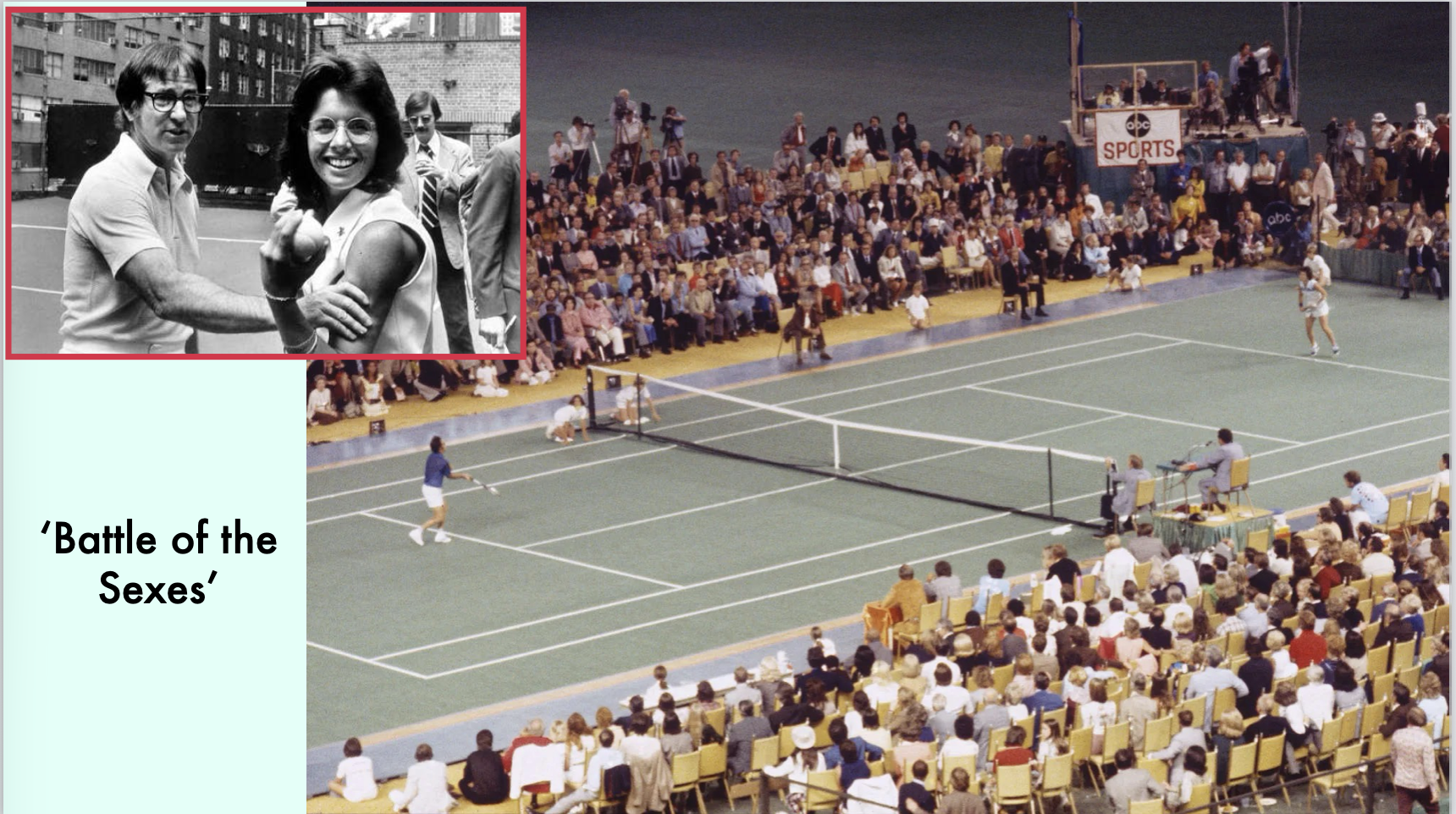
ON THIS DAY: 20 September 1973 – Billie Jean King defeats Bobby Riggs in the ‘Battle of the Sexes’
It was billed as a tennis match, but the stakes were far greater than sport. By 1973, Bobby Riggs was 55 years old, but he was no ordinary retired tennis player. A former world No. 1, Riggs had won the Wimbledon singles, doubles and mixed doubles titles in 1939. Now, he had reinvented himself as a flamboyant ‘tennis hustler’, gambler and self-proclaimed male chauvinist. Riggs loudly claimed that, even at 55, he could beat the best female tennis players in the world.
His first major challenge came from Australia’s Margaret Court, then one of the greatest female players of her generation, then 30 years old. On 13 May 1973, Riggs defeated her 6–2, 6–1. The humiliating result became known as the ‘Mother’s Day Massacre’ and generated enormous publicity.
Billie Jean King had initially refused to play Riggs. But after Court’s defeat, she changed her mind. She realised that this was no longer simply a publicity stunt: the credibility and future of women’s professional tennis were at stake. There was also a $100,000 winner-takes-all prize.
The match took place at the Houston Astrodome in Texas, in front of more than 30,000 spectators, while an estimated 90 million people watched around the world. The entrances were every bit as theatrical as the build-up. King arrived like Cleopatra, carried onto the court on a golden litter by members of the Rice University men’s track team. Riggs followed in a rickshaw pulled by female models, whom he dubbed his ‘Bosom Buddies’. He was dressed in a jacket emblazoned with the words ‘Sugar Daddy’.
King played along with the theatrics, presenting Riggs with a live piglet – a pointed joke about his chauvinistic image. Riggs responded by giving her a giant ‘Sugar Daddy’ lollipop. But once the show was over, it was time for serious tennis.
Riggs broke King’s serve early in the match, but she refused to be intimidated. She changed her tactics, patiently wore him down, and took control in what proved to be a straight-sets victory, 6-4, 6-3, 6-3. King had not merely defeated a 55-year-old former champion. She had beaten a former world No. 1 on one of the biggest sporting stages imaginable, at a time when women’s professional sport was fighting for recognition, equality and financial security.
King later revealed just how much pressure she had felt that night. She believed that a defeat could have set women’s tennis back decades and damaged the confidence of women far beyond the tennis court.Instead, her victory became one of the most famous moments in sporting history – a match in which far more than a tennis game was at stake.